Author: Jim Santiago

  • How Long Does a Florida Closing Take? House vs Condo

    A financed purchase of a single-family home in Florida usually closes about 30 to 45 days after the contract is signed. A cash purchase of a house is often about 1 to 3 weeks, if title is clean. A condo, or a house in an HOA that requires buyer approval, can use the same calendar, but association paperwork and the approval process are what usually stretch it.

    The contract sets the date. These ranges are typical, not a promise.

    Single-family house

    On a house, the clock is mostly the loan, the inspection period, and title.

    A lot of Florida houses are in an HOA too. Those files need an HOA estoppel the same way a condo does. Florida law generally requires the association to deliver it within 10 business days of a proper request, or 3 business days if you pay for a rush. A house with no association skips that step. A house in a mandatory HOA should not be written like a clean 14-day cash close until that estoppel is ordered.

    If the HOA has a right of approval, the estoppel is not the whole wait. The buyer still has to submit the association application, pay the application fee, and clear whatever the governing documents require. Some communities decide at a scheduled board meeting. If that meeting is two weeks out, the closing date moves even when the lender and title are ready. Read the approval deadline in the contract and match it to how that association actually meets.

    A mortgage file also needs an appraisal, underwriting, and a Closing Disclosure delivered at least 3 business days before you can sign. That federal waiting period is why a “we’re clear Thursday” often becomes a Monday closing.

    Cash skips the lender, so the file can move as soon as title is clear, the deposit is in, and any inspection issues are resolved. Title problems (an old lien, a probate, a name mismatch) slow cash deals the same way they slow financed ones. An HOA approval that is still pending will slow a cash house the same way.

    A simple house timeline often looks like this:

    • Escrow deposit in the first few days
    • Title search opened right away (chain of title, liens, judgments, open mortgages)
    • Inspection period, commonly about 10 to 15 days (whatever the contract says)
    • Title commitment issued once the search is back, with any exceptions listed
    • HOA estoppel ordered early if the house is in an association
    • HOA application submitted right away if the community requires buyer approval
    • Loan approval later in the file, if there is a mortgage
    • Title clears exceptions (payoffs, releases, or a requirement the parties have to satisfy)
    • Association approval in hand before the contract deadline, if one applies
    • Closing Disclosure at least 3 business days before signing, on a financed deal
    • Final walk-through a day or two before closing
    • Title prepares the settlement statement, you sign, and the deed records

    Signing at the title company is often 30 to 45 minutes once the file is clear.

    Condominium

    The loan and title work are the same. What every condo file has, and only some houses have, is the association.

    Title orders the condo estoppel early on purpose. A slow manager, a second association, or a special assessment that has to be sorted out is the usual reason a condo closing slips even when the lender is ready.

    Buyer approval is the other piece. Many condo associations require an application, a fee, and sometimes an interview or orientation before the sale can close. Approval often waits on a board meeting, not on the title company. Start that application as soon as the contract allows. A file can be clear to close and still sit until the board says yes.

    Buyers also need the association documents. Special assessments and reserve or milestone items (including a structural integrity reserve study on many buildings) get reviewed before anyone should pick a hard date.

    So: same 30 to 45 days is realistic for a straightforward financed condo when estoppel and approval are started immediately. Build in a buffer when the building has more than one association, a large assessment, a slow board calendar, or a history of slow estoppels.

    What actually moves the date

    Title can search, clear exceptions, and prepare the closing statement in parallel with the lender. What we cannot compress is a missing estoppel, an approval that is still in front of the board, an insurance binder that is not bound, or a Closing Disclosure that has not aged its three business days.

    If you are writing the offer, match the closing date to how the buyer is paying and whether the property needs association approval. A 14-day financed condo closing looks fast on paper and then waits on the estoppel and the board. A house in an HOA with an approval right can hit the same wall.

    This is general information about typical Florida timelines, not legal advice. Your contract, lender, and association control the dates on your file.

    Related reading

    FAQ

    How long does it take to close on a house in Florida?

    Often 30–45 days with a mortgage, and about 1–3 weeks for cash if title is clean. The contract sets the date.

    Do houses in an HOA take longer?

    They can. Those files need an HOA estoppel, and if the association must approve the buyer, the application and board schedule can add time a house with no association does not have.

    Do Florida condos take longer to close than houses?

    Loan and title timing are similar. Condos always have an estoppel and often a buyer-approval process. Only some houses do.

    How fast can a cash closing happen in Florida?

    Sometimes inside two weeks when title is clean and no association approval is pending. Liens, probate, a slow estoppel, or a board that has not met yet can wipe out that advantage.

    What is the 3-day rule before closing?

    If there is a mortgage, the lender must deliver the Closing Disclosure at least three business days before you sign.
  • Florida Condo and HOA Estoppel Certificates: What Buyers and Agents Should Know Before Closing

    Florida Condo and HOA Estoppel Certificates: What Buyers and Agents Should Know Before Closing

    If you’re buying a South Florida condo or HOA home, the estoppel certificate is one of the most important pre-closing documents in the file. It is the association’s official statement of what the unit or parcel owes, and what financial exposure a buyer may walk into after funding.

    Treating it as a last-minute checkbox is how deals stall, credits get renegotiated late, or surprises show up after closing.

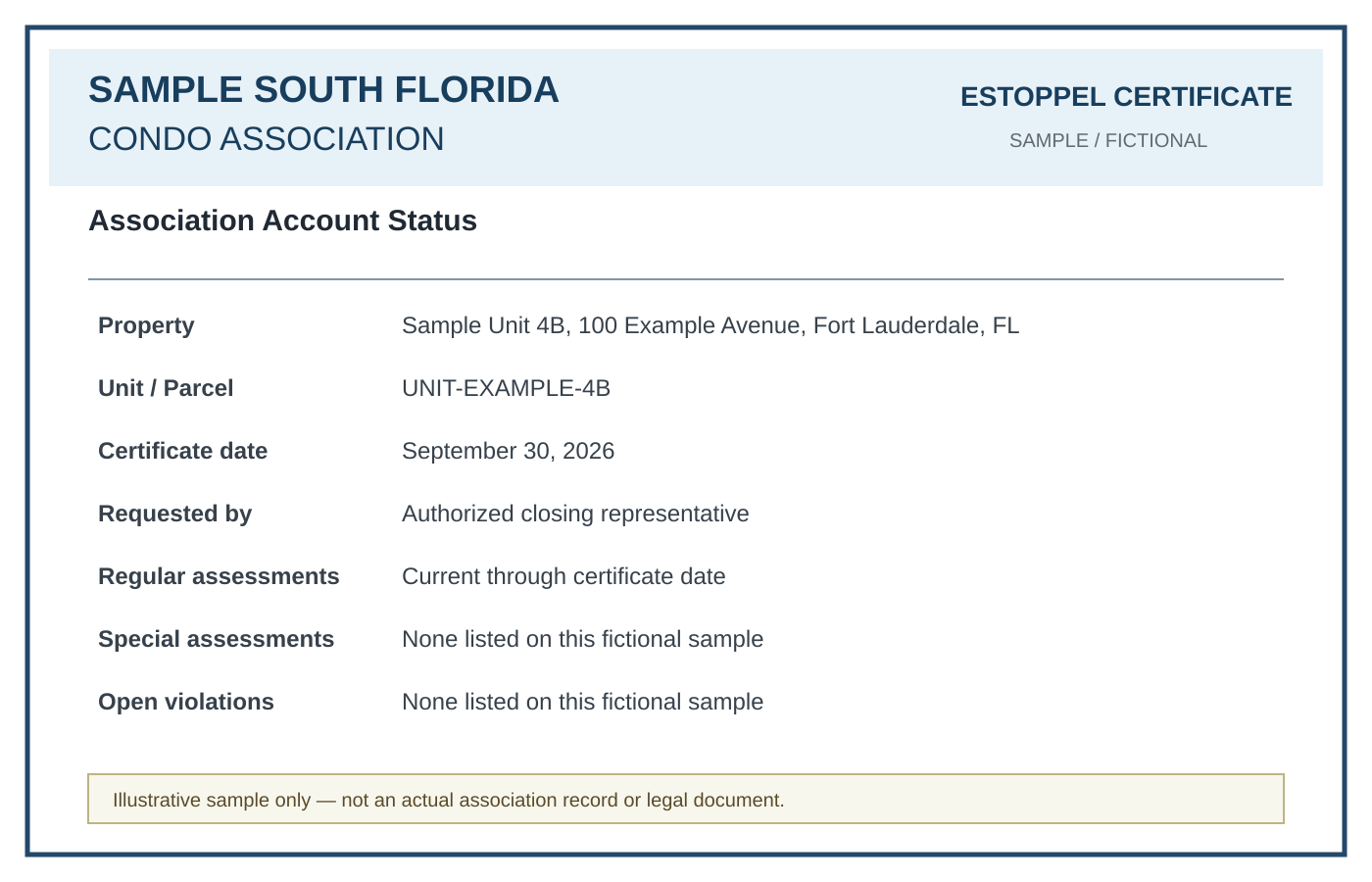
    Sample Florida condo association estoppel certificate
    Illustrative sample only: a fictional Florida association estoppel certificate.

    What an estoppel actually is

    An estoppel certificate is the association’s binding snapshot of amounts owed for that unit or lot as of the certificate date. Once issued, the association is generally limited in how it can later claim a different balance for the period covered by that certificate.

    For closings, that means:

    • Regular assessments and current balances matter
    • Special assessments and other amounts owed matter
    • Amounts scheduled to become due during the certificate’s effective period matter
    • Open association violations noticed to the current owner can matter on condo estoppels

    Paid monthly dues alone do not mean the file is clean.

    The timing agents often underestimate

    Under Florida law, condominium and HOA associations generally have 10 business days after a proper written or electronic request to issue the estoppel.

    That clock is not a courtesy window. Build it into the closing calendar early, especially when:

    • Financing or underwriting may slip
    • The property sits in both a condo association and a master/neighborhood HOA
    • The seller’s ledger and the first estoppel don’t match

    Once issued, an estoppel is typically valid for 30 days if delivered electronically or by hand, or 35 days if mailed. If the closing pushes past that window, a new certificate is usually needed and the request clock starts over.

    Rush options may exist for a shorter turnaround, often with an additional statutory fee. Fees are generally set by statute and can be higher when the account is delinquent. None of that is usually negotiable after the fact.

    One property, more than one estoppel

    Many South Florida properties are subject to more than one governing body. A condo unit may also sit under a master association. Each association may need its own estoppel, on its own timeline, with its own fee.

    If your contract calendar only budgets for one certificate, you are already behind.

    What to compare before you rely on it

    A strong pre-closing review does more than confirm “dues current.” Ask the title and closing team to help line up:

    1. The estoppel certificate itself
    2. The current association ledger
    3. Seller disclosures and assessment notices
    4. Contract language on who pays regular dues, special assessments, and estoppel fees
    5. Any pending special assessments or reserve catch-up work already approved
    6. Open association violations (separate from the money balance)
    7. Municipal lien / open-permit / code issues, which an association estoppel does not replace

    This fits the same diligence pattern as reviewing condo special assessments and Florida condo SIRS before funding.

    Why title and closing care

    Unpaid assessments can follow a buyer after transfer under Florida condo and HOA rules in ways that surprise people who assumed “seller pays everything at closing.” The estoppel is how the closing table tries to pin down the association’s position before funds disburse.

    It will not replace:

    • A full title search and title insurance review
    • Municipal lien and permit diligence
    • Lender condo/HOA questionnaire and warrantability analysis

    Those are parallel tracks, not substitutes.

    Practical checklist for Fort Lauderdale and South Florida deals

    • Order estoppels early, not the week of closing
    • Confirm every association that must issue one
    • Calendar the 10-business-day issue window and the 30/35-day validity window
    • Compare estoppel vs ledger vs seller disclosures in writing
    • Reconcile who pays fees and assessments in the contract and on the settlement statement
    • Re-order if the closing date slips past validity

    FAQ

    How long does a Florida condo or HOA have to issue an estoppel?

    Generally 10 business days after a proper written or electronic request from an eligible requester.

    How long is the certificate good for?

    Typically 30 days if delivered electronically or by hand, or 35 days if mailed.

    Does one estoppel cover everything?

    Not if the property is under more than one association. Each governing entity may need its own certificate.

    Does an estoppel replace a municipal lien search?

    No. Association balances and city/county compliance are different diligence tracks.

    Closing with a Fort Lauderdale title company

    Independent Title of Fort Lauderdale (dba Florida’s Best Title Company) helps South Florida buyers, sellers, and agents keep association estoppels, assessments, and closing timelines aligned so funding day is not the first time the numbers get real.

    Questions on a condo or HOA file in Broward or nearby? Call (954) 493-8288 or visit indytitleftl.com.

    Disclaimer

    This article is for general informational purposes only and is not legal advice, a title opinion, or a substitute for advice from a licensed Florida attorney or title professional. Association rules, statutes, fees, and forms change. Readers should verify current Florida law and their specific contract and closing file with qualified counsel.

  • Condo Special Assessments in South Florida: What Buyers and Agents Need Before Closing

    Market Snapshot

    Why condo special assessments South Florida dominate 2026 closings

    If you buy or sell condos in Miami-Dade, Broward, or Palm Beach, condo special assessments South Florida are no longer a rare negotiation footnote. They show up in listing remarks, lender questionnaires, association estoppels, and — when nobody asked early — on the settlement statement the week of funding.

    On September 5, 2026, realtor Li Bensimon published an MLS count of every active condo listing within 15 miles of downtown Miami. Of the listings that answered the special-assessment field, 23.7% declared one — roughly 1 in 4. In buildings finished before 1998, the share rose to 35.9%; in 1998-or-later buildings it was 10.8%. South Florida condos overall declared at about 17.8%, while houses on the same field sat near 3.8%. This is a condominium story, not a generic Florida housing story.

    This article is general market and closing information for buyers, agents, and closings teams — not legal, tax, or lending advice. Every building and contract is different.

    The numbers

    What the September 2026 MLS snapshot showed

    Key takeaways agents can use in listing appointments and buyer consults:

    ~1 in 4 answered Miami listings declared a special assessment (23.7% of those that filled the MLS field).

    Age drives risk — pre-1998 buildings declared at 35.9% vs 10.8% for newer stock; 1970s towers led near 40%.

    Coast vs core — Aventura ~32%, Surfside/Bal Harbour ~25%, vs Brickell ~13% and Downtown ~12%.

    Price matters — under-$500k listings declared far more often than $3M+ inventory, where buildings are newer.

    Blanks are not “no” — thousands of listings left the field empty; silence is not reassurance.

    Floor, not census — the count is what agents declared. Actual assessments can still surface in estoppels.

    Due diligence

    What buyers and agents should check before funding

    Treat the MLS checkbox as a starting point, then pull the association package early — ideally before anyone waives contingencies they cannot live with:

    Estoppel / condo questionnaire — what the association says is owed, pending, or approved.

    Levy vs rumor — already levied amounts vs board discussion / planned work only.

    Payment schedule — lump sum, installments, or association loan / line of credit.

    SIRS & milestone status — whether structural work is done, underway, or still pending. See our SIRS closing guide.

    Reserves & budgets — last two budgets and the latest reserve / SIRS study.

    Master insurance — declarations and deductibles lenders will scrutinize for warrantability.

    For affordable or older condo stock, layer this with inspection and insurance timing from our affordable homes tips and the Florida home buyer guide.

    At closing

    How special assessments show up on the settlement statement

    At Independent Title of Fort Lauderdale (Florida’s Best Title), the association package is not a formality. We order estoppels early, confirm what the association reports as owed, and allocate levied vs future assessments per the contract so title can transfer clean.

    Who pays is usually driven by whether the assessment was already levied and by what the purchase contract says. Levied amounts are often the seller’s responsibility (paid or credited at closing). Assessments first arising after closing typically follow the buyer. Confirm it in writing — do not assume custom.

    Florida Statutes §718.116 addresses unpaid assessments, interest, late fees, lien priority, and joint liability of the new owner for amounts unpaid through transfer. That is why an open assessment is a closing problem, not only an ownership footnote. This is a general summary of public statute language — not legal advice for any specific file.

    Walk the full timeline on our Florida closing process page, or open with our real estate closings team in Broward, Miami-Dade, and Palm Beach.

    Closer tip: In many Florida transactions the buyer can choose the title and settlement company. If you want association docs ordered early and special assessments handled cleanly on the settlement statement, tell your agent you would like to close with Florida’s Best Title / Independent Title of Fort Lauderdale. Call (954) 493-8288 or run a soft closing-cost estimate on our homepage.

    FAQ

    Frequently asked questions

    How common are condo special assessments in South Florida right now?

    In Li Bensimon’s September 5, 2026 Miami MLS count, about 23.7% of condo listings that answered the special-assessment field declared one — roughly 1 in 4. The South Florida condo share was about 17.8%, versus about 3.8% for houses on the same field. Older coastal buildings declare far more often than post-2005 urban-core stock.

    Does a declared special assessment mean the building is unsafe?

    No. It means the association levied a charge beyond the regular budget — which can be for concrete, roof, seawall, elevators, insurance, or reserve catch-up. Many well-run buildings carry one precisely because they are doing the work. The MLS field also only records what the agent declared, so treat it as a floor, not a full census.

    Who pays a special assessment at closing?

    Usually driven by whether it was already levied and by what the contract says. Levied amounts are often the seller’s responsibility (paid or credited at closing); future assessments after closing typically follow the buyer. Confirm in writing — and verify against the estoppel, not only the listing remarks.

    What should I pull this week if I have a condo under contract?

    Send the association documents to your lender and your closer the same day. Ask specifically about special assessments (levied vs pending), SIRS / milestone status, reserves, litigation, and master insurance. Blank MLS fields are a reason to ask more questions, not fewer.

    What does Florida Statutes §718.116 mean for buyers?

    In general terms, unpaid assessments can accrue interest and late fees, the association may hold a lien, and a new owner can be jointly liable with the prior owner for amounts unpaid through transfer. That is why open assessments must be cleared or credited on the settlement statement. This is general information only — not legal advice.

    Explore

    Keep reading

    Sources. Aggregate MLS statistics cited from Li Bensimon, Miami Condo Special Assessments, Active Listings by Year Built, Price and Area, September 2026 (bensimonluxury.com; MIAMI MLS via Bridge, active listings as of September 5, 2026, field MIAMIRE_SpecialAssessmentYN; CC BY 4.0 aggregate tables). Florida Statutes §718.116 summarized for general information only — not legal advice. Figures change by building and month; verify current association documents for any specific property. Independent Title of Fort Lauderdale, Inc. d/b/a Florida’s Best Title — 2881 E Oakland Park Blvd, Suite 302, Fort Lauderdale, FL 33306 — (954) 493-8288.

  • Florida Condo SIRS, Special Assessments, and What They Mean at Closing

    Market Insight

    Why condo deals are stalling on paperwork

    South Florida condo deals used to stall on appraisal or HOA timing. In 2026, they more often stall on paperwork the building itself has to produce: milestone inspections, a Structural Integrity Reserve Study (SIRS), reserve funding, and — when the association is catching up on deferred maintenance — special assessments that can run from tens of thousands of dollars per unit into six figures in reported cases.

    This is general market information from public reporting, not legal, tax, or lending advice. Every building and contract is different.

    The signals

    Why this is the hot topic

    After Surfside, Florida required taller condo buildings to complete milestone structural inspections and a SIRS covering major structural components. Associations generally cannot keep waiving or underfunding those structural reserves the way many did for years. The catch-up shows up as higher dues, special assessments, and stricter lender review of the project.

    Buyers and agents feel it first as financing friction. A building that is behind on inspections, reserves, insurance, or assessment funding can be labeled non-warrantable for conventional (Fannie/Freddie) loans. That does not always kill the deal — cash, portfolio, and non-QM programs still close many of these — but it shrinks the buyer pool and changes pricing and timelines.

    Due diligence

    What agents and buyers should pull early

    Before anyone falls in love with a unit, ask for:

    Estoppel / condo questionnaire — confirm the association path and what is owed.

    SIRS & milestone status — whether work is done, underway, or only planned.

    Master insurance — declarations and deductibles lenders will scrutinize.

    Special assessments — levied vs pending, and who pays under the contract.

    Litigation — known association lawsuits that affect warrantability or clear title timing.

    Don’t wait for underwriting — discovering a large assessment in week three is how contracts blow up.

    At the table

    What this means at closing

    At Independent Title of Fort Lauderdale, the association package is not a formality. We order estoppels early, confirm what the association says is owed, and handle prorations and assessment treatment per the contract so title can transfer clean. A levied assessment that must be paid or credited at closing becomes a line on the settlement statement — messy only when nobody asked until the last week.

    If you are selling, know your building’s status before you list so you price for the real buyer pool. If you are buying, have your lender weigh warrantability before you waive contingencies you cannot live with. For Miami and Broward condo denser markets, see our Miami, Miami-Dade, and Broward pages, and walk the full Florida closing process.

    Closer tip: In many Florida transactions the buyer can choose the title and settlement company. If you want association docs ordered early and assessments handled cleanly on the settlement statement, tell your agent you would like to close with Independent Title of Fort Lauderdale. Call (954) 493-8288.

    FAQ

    Frequently asked questions

    Is every older Florida condo non-warrantable?

    No. Many buildings that completed inspections, fund required reserves, and carry acceptable master insurance still finance conventionally. The risk is concentrated where documents are incomplete or assessments or structural issues are unresolved.

    Who pays a special assessment at closing?

    Usually driven by whether it was already levied and by what the contract says. Levied amounts are often the seller’s responsibility (paid or credited at closing); future assessments after closing typically follow the buyer. Confirm in writing — do not assume custom.

    Can a deal still close if conventional financing is out?

    Often yes, with cash or specialty lending, but expect different down payment, rate, and timeline. Clear association documents still matter for title and for the lender you do use.

    What should I do this week if I have a condo under contract?

    Send the association documents to your lender and your closer the same day. Ask specifically about SIRS, milestone status, assessments, and master insurance.

    Explore

    Keep reading

    Sources. Public coverage of Florida SIRS and milestone rules; industry reporting on special assessments and non-warrantable condo financing; Florida Realtors / market reporting on 2026 inventory and prices. Figures change by building and month — verify current documents for any specific property.

    Not legal advice. Independent Title of Fort Lauderdale, Inc. is a title insurance and real estate settlement services company — it is not a law firm and does not provide legal, tax, financial, or insurance advice. This page is general information only. Programs, promulgated rates, taxes, insurance rules, inspection standards, and market conditions change over time and vary by lender, insurer, property, and county. Confirm current details for your specific situation with the appropriate licensed professional — such as a licensed attorney, mortgage lender, insurance agent, surveyor, or tax advisor — before making decisions. Marketing and lead-generation ideas are provided for general educational purposes and should be carried out in compliance with all applicable rules, including RESPA and your brokerage’s policies.